Article
Prioritization: The Sales Prospecting Step You Can’t Afford to Skip

Table of Content
If you’ve been involved in sales prospecting, you understand the cost of pursuing a bad lead or company target. With a comprehensive prospect/lead prioritization strategy, you can identify not only the best companies but the best people to target. Equally important, you can understand who you shouldn’t target. By implementing a structured, comprehensive approach to prioritizing accounts and prospects, sales teams can quickly hone-in on high-value target accounts/personas and significantly cut waste. In this blog, we’ll explore four key predictive buying signals that sales (and marketing) teams can utilize in conjunction to ensure strategic, efficient, and effective resource allocation at all stages of the sales funnel.
Why is prioritization so important?
Prioritizing your best accounts in B2B sales prospecting is essential for maximizing efficiency, improving conversion rates, and driving revenue growth. Sales teams have limited time and resources, so focusing on high-fit, high-value prospects ensures they engage with companies that are more likely to buy. Without prioritization, reps waste time chasing leads that may never convert, leading to inefficiencies and missed opportunities. By strategically identifying and ranking accounts based on predictive fit models leveraging first party results/third-party firmographic data and intent signals, sales teams can concentrate their efforts on the most promising account prospects.
A well-defined account prioritization strategy also shortens the sales cycle by enabling reps to engage decision-makers at the right time. High-priority accounts often exhibit clear buying signals, such as recent funding, executive changes, or product expansions, indicating a higher likelihood to purchase. Leveraging data-driven insights allows sales teams to tailor their outreach, making it more relevant and compelling. By focusing on accounts that are actively researching solutions or demonstrating intent, sales reps can increase their chances of converting prospects into customers faster.
Another critical benefit of prioritizing key accounts is the ability to align sales and marketing efforts for a more effective go-to-market (GTM) strategy. When both teams work from a shared list of high-value accounts (TAM), marketing can support sales with targeted campaigns, personalized content, and account-based marketing (ABM) tactics. This alignment ensures that sales reps are engaging with warmed-up leads who have already been nurtured through various marketing touchpoints. As a result, sales teams spend less time on cold outreach and more time closing deals with prospects who are already familiar with the brand.
How are buying signals and AI-scoring models used to prioritize accounts and prospects?
Intent signals are often the first indicator that B2B companies use to gauge interest, making them a fundamental component of Account-Based Marketing (ABM) strategies. These signals are third-party data points that reveal which domains are actively searching for a particular topic. Many providers, including Leadspace, offer this data, making it accessible to any company in the market—including competitors. Intent data is particularly valuable for identifying accounts that are in the buying stage, provided that the right search terms have been selected and continuously updated. While this signal is useful for narrowing down a Total Addressable Market (TAM), it raises the question: Are the accounts showing high intent the right ones for your business? Prospecting based on intent data alone can lead to more harm than good as it might point you towards prospects that aren’t likely to buy your product.
A Company Fit or propensity model can help answer this by determining which of the intent-surging accounts are the best fit for your company. These models analyze historical data and Ideal Customer Profile (ICP) attributes across your TAM, leveraging AI-driven algorithms to score accounts based on various buying signals. This scoring helps identify not only which accounts are most likely to purchase now but also those that could be potential buyers in the future. Fit models play a crucial role in prioritizing accounts for investment, ensuring that campaign budgets and sales resources are directed toward opportunities with the highest likelihood of conversion. The best candidates for high-touch engagement are those with strong Fit and Intent scores.
Once high-priority accounts have been identified, the next step is determining the right individuals within those companies to engage with. A persona model is useful for categorizing buyer Fit by analyzing factors such as job title, seniority level, skills, and expertise. Since many businesses offer solutions that cater to different personas, a structured model helps assign a lead to the most relevant category. This approach is particularly beneficial not only for outbound targeting but for inbound lead funnel prioritization and response. This is particularly true since job titles and roles vary across industries and regions. By systematically organizing contacts into personas, companies can align leads with the right product offerings and identify their potential influence in the buying process.
The final consideration is whether the right person within the right account is actually prepared to engage. This is best assessed by evaluating their interactions with your sales and marketing efforts. Marketing engagement scores provide valuable insights into a prospect’s readiness by tracking their level of interaction with content, campaigns, and direct outreach. First-party intent can be very informative here too by showing not only the companies, but in the United States often the individuals who are actively investigating your site. By combining persona Fit with engagement scores, companies can more effectively determine which leads in their database are most likely to convert and which new prospects are primed for outreach.
What are best practices for account and prospect prioritization?
The best strategy by which sales teams can effectively implement a data-driven approach to prioritizing accounts and prospects is by developing heatmaps, or by simply filtering your TAM by a combination of predictive scores. The heatmaps (ex. images below), let you visually explore the accounts across your TAM by their predictive scores, making it easy to develop the best possible strategy for allocating valuable sales resources by tiers (likelihood of success).
Tier 1 – High-value, high-fit enterprise accounts (Dedicated, personalized outreach)
Tier 2 – Mid-market accounts showing strong interest (Targeted campaigns)
Tier 3 – Lower-priority accounts (Automated nurture sequences)
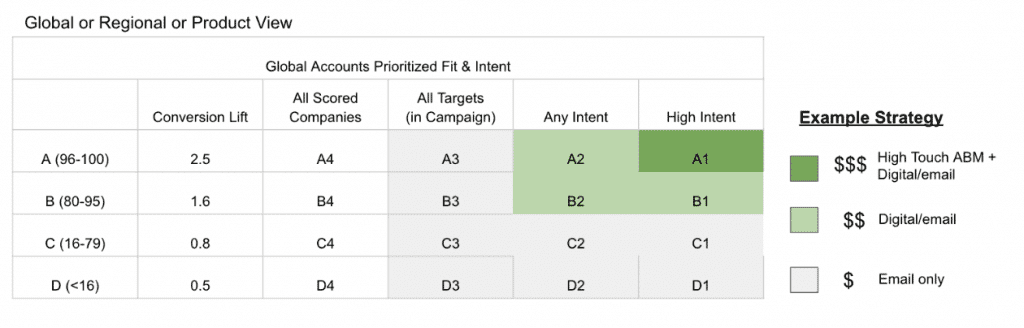
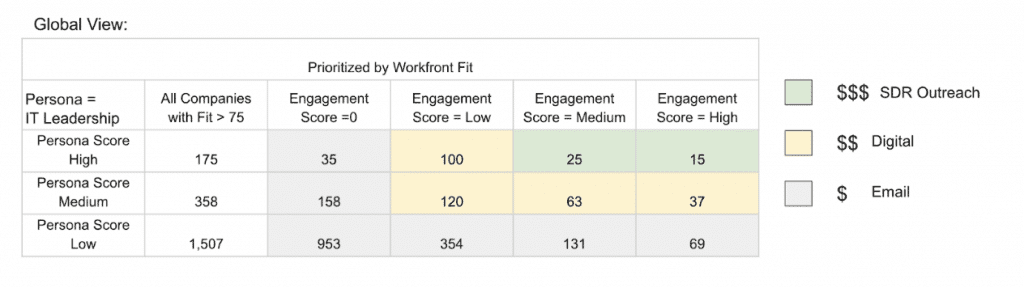
Prioritizing your best segments across your TAM involves leveraging four predictive AI-models to generate scores – which become the most significant buying signals for you to consider. Start by identifying the accounts/companies that are most likely to buy your product using Fit and Intent models, and then identify the people within them who are most likely to make it happen using Persona models and engagement scores. Let’s explore the four steps (predictive signals) that go into identifying your best prospects:
Step #1: Identify the Right Companies with Fit Scoring
A propensity (or Fit) model is built from your historical conversion data set (opportunities). Applies scoring that indicates a company and/or person’s likelihood to be a good target buyer. Use cases include propensity to buy, inbound lead conversion, higher LTV, upsell/cross-sell, etc.
Industry & company size (number of employees, revenue)
Technology stack (e.g., CRM, marketing automation tools)
Geographic location (if relevant)
Step #2: Identify the Ready Companies with Intent Scoring
An intent model is a weekly set of customized signals that monitors your accounts for intent (3rd-party and/or 1st-party), and applies scoring based on the level of intent activity specific to a customers’ products/category.
Company / 3rd-Party Intent: See the companies that are searching your topics and competitors this week to know who is in-market.
Metro-Intent: Use their locations to identify the specific people you need to engage with at a target account.
Product-Level Intent: Know which product they’re searching to understand the problems they’re looking to solve for personalized outreach.
Website / 1st-Party Intent: See who has been on your website – get an idea of how strongly they’ve considered your solution.
Buying committee activity – Multiple people from the same company visiting your site.
Competitor engagement – Prospect has engaged with competitors (switching opportunity).
Step #3: Identify the Right People with Persona Scoring
A persona model based either on standard personas, or your custom persona profiles, to 1) score the existing database and inbound leads based on their closest persona fit (including skills and other identifiers), and 2) find net-new contacts within accounts that lack the right buyers using persona targeting.
Job titles & decision-makers (e.g., CTOs, Heads of Sales)
Pain points & business challenges
Expertises, specialties and experience
Step #4. Identify the Ready People with Engagement Scores
Your external 1st-party scoring model that is built through either simple point scoring for engagement in a marketing program or interaction with website content. It is typically implemented within the Marketing Automation Platform (Marketo, Eloqua, Pardot, Hubspot, etc.) and the higher the score the more engaged the buyer. Prioritize warm inbound leads over cold outbound.
Prospects engaging with emails, calls, or social content are more likely to convert.
Form fills & demo requests – Highest priority since they show immediate intent.
Email engagement – Leads who opened/clicked marketing emails.
Website visits – Prospects who visited pricing/product pages multiple times. In the United States, often first party intent can be resolved to the visitor level as opposed to just the company. This is particularly valuable for fast and targeted response.
Conclusion:
Ultimately, prioritizing the best accounts leads to better forecasting and more predictable revenue growth. When sales teams focus on accounts that fit their Ideal Customer Profile (ICP) and demonstrate intent, they build a healthier, more consistent sales pipeline. This data-driven approach reduces guesswork and enables sales leaders to allocate resources effectively, ensuring reps are working on the highest-impact opportunities. In a competitive B2B landscape, the ability to prioritize and engage the right accounts and prospects at the right time can be the difference between meeting revenue targets and falling short.
By prioritizing prospects effectively, your teams will see:
Higher conversion rates – Focusing on high-fit leads increases chances of closing deals.
Shorter sales cycles – Engaging with ready-to-buy prospects speeds up deal flow.
Efficient resource allocation – Reps spend time where they have the highest impact.
Improved revenue forecasting – A structured approach leads to more predictable pipelines.
Don’t forget to align Sales and Marketing on Lead Scoring. Identify “Low-Hanging Fruit” and determine what your sales-ready triggers are. Certain external signals indicate a higher likelihood to buy. Sales & marketing teams should collaborate to define top-tier accounts and customize outreach accordingly. For more information about using predictive models to identify your best accounts, get the Leadspace Revenue Radar guide.
Latest Articles

Article
How to audit and fix duplicate CRM records in 2026
Your CRM is supposed to be the system of record for your entire go-to-market operation. In practice, it often becomes a graveyard of duplicate contacts, mismatched accounts, and stale fields that no one trusts. When that happens, every downstream system that depends on CRM data starts making bad decisions.
Scoring models weight the wrong signals. Routing sends leads to the wrong reps. Segmentation breaks. Campaigns reach the same buyer five times across three different records. The problem is not that your team is careless. The problem is that CRM data quality issues compound fast, especially when you are pulling data from multiple sources and running enrichment at scale.
This guide walks through how to find the root causes of duplicate records, build governance rules that hold, and maintain data validation and cleansing as an ongoing operation rather than a quarterly fire drill.

Article
Measuring TAM coverage, not just TAM size
You already know your TAM number. That number looks useful in planning decks and board slides. It tells you how many accounts fit your ICP and how much revenue sits in the market.
It does not tell you whether your team has enough territory coverage to work that market well.
That gap matters. In outbound TAM development, territory performance depends on coverage over volume. If you assign a large market without measuring who you can reach, who you can route, and who you can engage across the buying group, you create blind spots inside your territory model.
This is whereEnterprise Data Management becomes operational. It gives you a way to measure TAM coverage at the account, contact, and buying group level. You stop asking how big the market is. You start asking how much of it your team is equipped to work right now.

Article
Turning account engagement into buying momentum with Custom Audiences
Account engagement rarely fails from lack of activity. It fails when you see activity at the account level but miss who is driving it, how interest is spreading, and when to act. That gap slows follow-up, weakens targeting, and leaves pipeline exposed.
If you want stronger account engagement, you need more than account coverage. You need Custom Audiences built from buying-team signals. That gives you a way to move from broad account reach to coordinated influence across the people who shape a deal.
That shift matters because B2B buying is already group-driven. According to 6sense research, 92% of B2B purchases involve groups of three or more people. A lead-centric model misses that reality. Your targeting should reflect the full buying team.