Product sheet

Leadspace Platform Overview

Unify Your Data. Accelerate Your Pipeline. Win More Business.
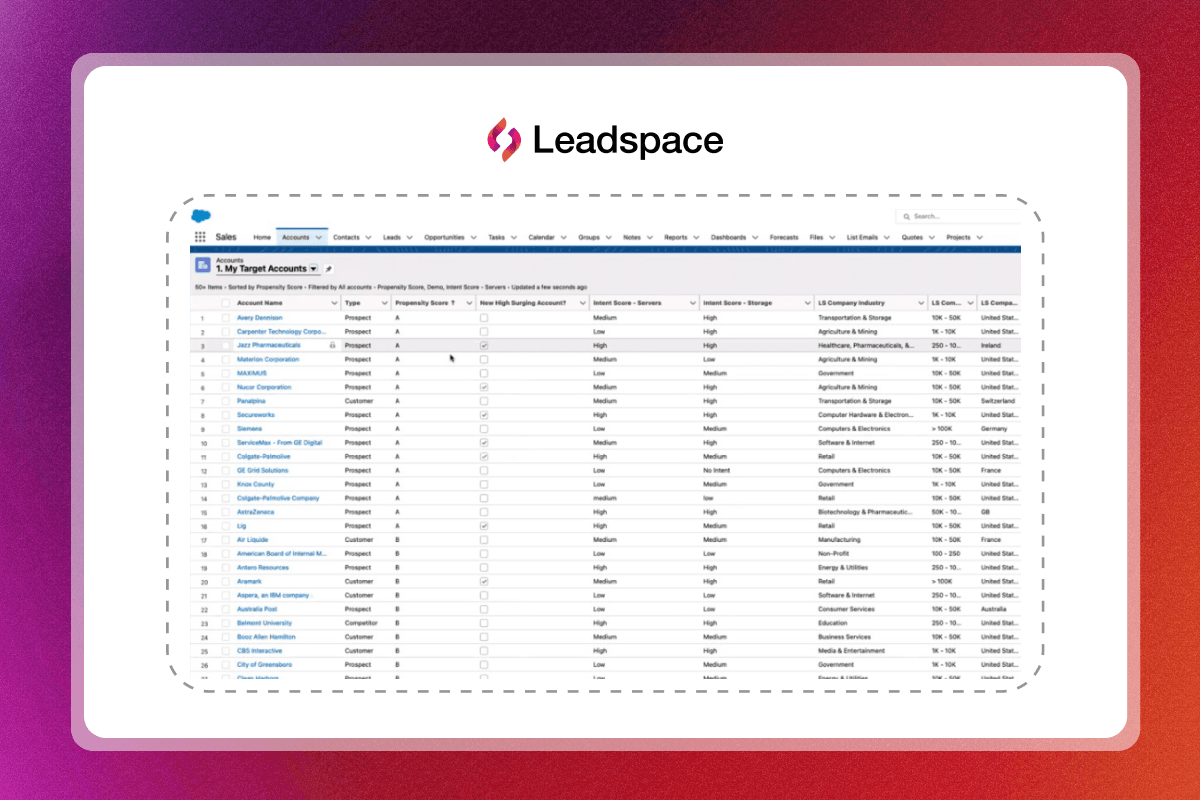
Metro Intent Data
Metro Intent Data
Metro Intent Data
Metro Intent Data

In B2B sales and marketing, data should be your competitive edge – not your biggest obstacle. But for most revenue teams, bad data is silently eroding pipeline, slowing down sales cycles, and hiding high-value opportunities in plain sight. Disjointed CRMs, fragmented marketing systems, incomplete lead records, and static TAM lists leave your teams flying blind. And in today’s AI-driven GTM landscape, that’s not just inefficient – it’s dangerous. Leadspace exists to solve this.

We’re not just another data provider – we’re the AI-powered GTM Data Intelligence Cloud built for B2B teams, by B2B data experts. Our platform unifies, enriches, scores, and activates your buyer data in real time, across every GTM motion – from inbound lead management to outbound TAM development to full-scale data hygiene.

Latest Articles
GTM Data Governance

Article

Why Data Governance Is Now a Revenue Function

For a long time, data governance lived in the background of the business.


It sat inside IT. Sometimes legal. Occasionally security... It was something you needed for compliance audits, privacy policies, and system hygiene, but it rarely gets associated with pipeline creation or revenue performance. If anything, governance was seen as something that slowed go-to-market teams down. It was an approval layer or process hurdle that prevented a campaign from launching this week.


But that mental model was built for a very different GTM environment than the one enterprise revenue teams are operating in right now.

GTM Data Governance

Article

Why Data Governance Is Now a Revenue Function

For a long time, data governance lived in the background of the business.


It sat inside IT. Sometimes legal. Occasionally security... It was something you needed for compliance audits, privacy policies, and system hygiene, but it rarely gets associated with pipeline creation or revenue performance. If anything, governance was seen as something that slowed go-to-market teams down. It was an approval layer or process hurdle that prevented a campaign from launching this week.


But that mental model was built for a very different GTM environment than the one enterprise revenue teams are operating in right now.

GTM Data Governance

Article

Why Data Governance Is Now a Revenue Function

For a long time, data governance lived in the background of the business.


It sat inside IT. Sometimes legal. Occasionally security... It was something you needed for compliance audits, privacy policies, and system hygiene, but it rarely gets associated with pipeline creation or revenue performance. If anything, governance was seen as something that slowed go-to-market teams down. It was an approval layer or process hurdle that prevented a campaign from launching this week.


But that mental model was built for a very different GTM environment than the one enterprise revenue teams are operating in right now.

Identifying B2B Buying Teams

Product sheet

Leadspace Buying Team Intelligence

B2B deals don’t close because one contact engages, they close when an entire buying committee aligns. Yet most GTM systems still operate at the individual record level, leaving revenue teams blind to the relationships, roles, and signals that actually drive decisions.


Leadspace’s Buying Team Intelligence makes buying groups visible, measurable, and actionable by connecting people to roles, accounts, hierarchies, and real-time buying signals in a unified, living data graph.


The result: sales, marketing, and RevOps teams can identify who truly influences and approves decisions, prioritize accounts showing coordinated buying activity, and orchestrate multithreaded engagement based on how buyers actually buy rather than on how CRM records are structured.

Identifying B2B Buying Teams

Product sheet

Leadspace Buying Team Intelligence

B2B deals don’t close because one contact engages, they close when an entire buying committee aligns. Yet most GTM systems still operate at the individual record level, leaving revenue teams blind to the relationships, roles, and signals that actually drive decisions.


Leadspace’s Buying Team Intelligence makes buying groups visible, measurable, and actionable by connecting people to roles, accounts, hierarchies, and real-time buying signals in a unified, living data graph.


The result: sales, marketing, and RevOps teams can identify who truly influences and approves decisions, prioritize accounts showing coordinated buying activity, and orchestrate multithreaded engagement based on how buyers actually buy rather than on how CRM records are structured.

Identifying B2B Buying Teams

Product sheet

Leadspace Buying Team Intelligence

B2B deals don’t close because one contact engages, they close when an entire buying committee aligns. Yet most GTM systems still operate at the individual record level, leaving revenue teams blind to the relationships, roles, and signals that actually drive decisions.


Leadspace’s Buying Team Intelligence makes buying groups visible, measurable, and actionable by connecting people to roles, accounts, hierarchies, and real-time buying signals in a unified, living data graph.


The result: sales, marketing, and RevOps teams can identify who truly influences and approves decisions, prioritize accounts showing coordinated buying activity, and orchestrate multithreaded engagement based on how buyers actually buy rather than on how CRM records are structured.

Waterfall Logic

Article

Why Waterfall Logic Matters in B2B Data Aggregation

Modern go-to-market teams are swimming in data – firmographics, technographics, intent signals, engagement scores, and countless enrichment sources.


But here’s the truth: more data doesn’t automatically make your business smarter. It often just makes it messier.


When multiple data vendors, enrichment tools, and APIs are all trying to update the same record, the result is chaos – inconsistent fields, conflicting values, duplicates, and manual clean-up that never ends.


That’s where waterfall logic becomes a game-changer.

Waterfall Logic

Article

Why Waterfall Logic Matters in B2B Data Aggregation

Modern go-to-market teams are swimming in data – firmographics, technographics, intent signals, engagement scores, and countless enrichment sources.


But here’s the truth: more data doesn’t automatically make your business smarter. It often just makes it messier.


When multiple data vendors, enrichment tools, and APIs are all trying to update the same record, the result is chaos – inconsistent fields, conflicting values, duplicates, and manual clean-up that never ends.


That’s where waterfall logic becomes a game-changer.

Waterfall Logic

Article

Why Waterfall Logic Matters in B2B Data Aggregation

Modern go-to-market teams are swimming in data – firmographics, technographics, intent signals, engagement scores, and countless enrichment sources.


But here’s the truth: more data doesn’t automatically make your business smarter. It often just makes it messier.


When multiple data vendors, enrichment tools, and APIs are all trying to update the same record, the result is chaos – inconsistent fields, conflicting values, duplicates, and manual clean-up that never ends.


That’s where waterfall logic becomes a game-changer.