Product sheet
Leadspace for Mergers & Acquisitions
Unify, Enrich, and Activate Your Customer Data for Post-Merger Success.
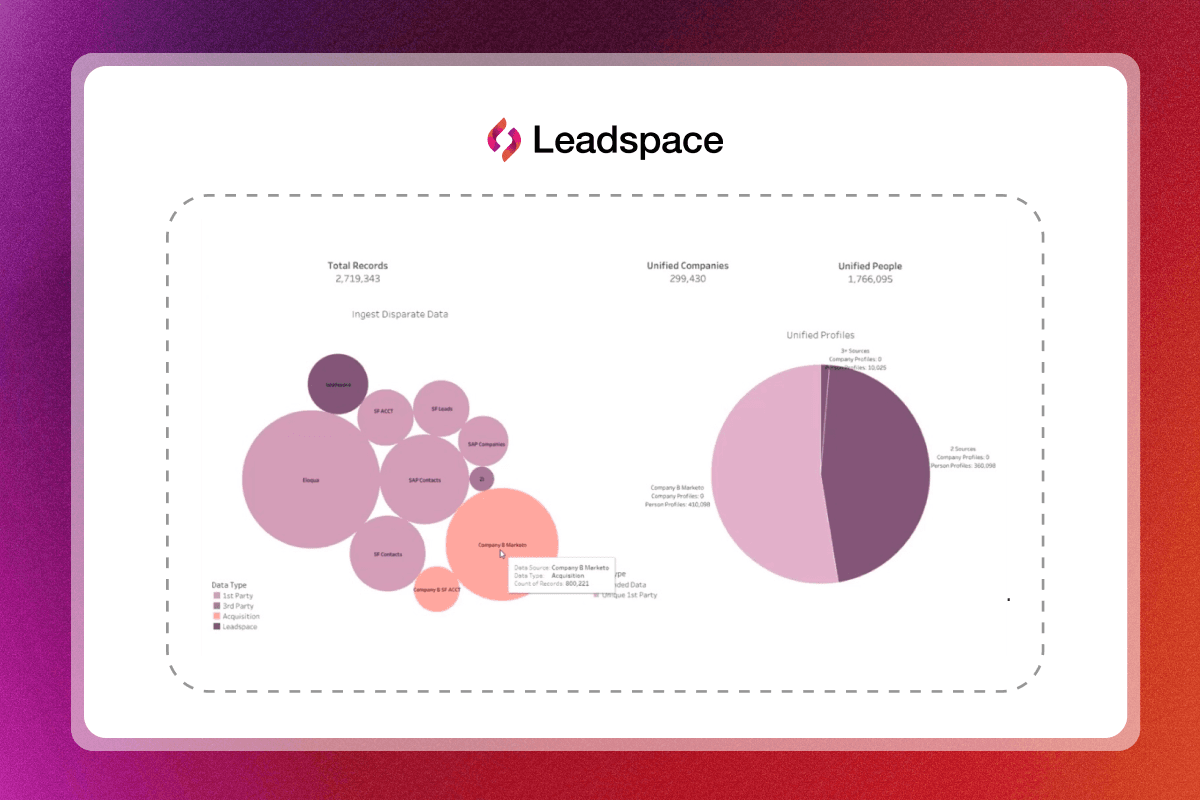
The Challenge? Data Chaos After the Deal.
Mergers and acquisitions bring opportunity – and massive complexity. When two organizations join forces, their data doesn’t just double – it multiplies in complexity. Different CRMs, data vendors, enrichment tools, and field structures create a tangle of conflicting records and overlapping accounts.
• Duplicate and conflicting account data across systems
• Fragmented contact and buying group visibility
• Different taxonomies and scoring models between sales and marketing teams
• Overlapping vendors and enrichment contracts driving up cost and confusion
The result? GTM teams struggle to identify the combined Total Addressable Market (TAM), build accurate account hierarchies, and execute cohesive campaigns.
Latest Articles

Article
How to audit and fix duplicate CRM records in 2026
Your CRM is supposed to be the system of record for your entire go-to-market operation. In practice, it often becomes a graveyard of duplicate contacts, mismatched accounts, and stale fields that no one trusts. When that happens, every downstream system that depends on CRM data starts making bad decisions.
Scoring models weight the wrong signals. Routing sends leads to the wrong reps. Segmentation breaks. Campaigns reach the same buyer five times across three different records. The problem is not that your team is careless. The problem is that CRM data quality issues compound fast, especially when you are pulling data from multiple sources and running enrichment at scale.
This guide walks through how to find the root causes of duplicate records, build governance rules that hold, and maintain data validation and cleansing as an ongoing operation rather than a quarterly fire drill.

Article
Measuring TAM coverage, not just TAM size
You already know your TAM number. That number looks useful in planning decks and board slides. It tells you how many accounts fit your ICP and how much revenue sits in the market.
It does not tell you whether your team has enough territory coverage to work that market well.
That gap matters. In outbound TAM development, territory performance depends on coverage over volume. If you assign a large market without measuring who you can reach, who you can route, and who you can engage across the buying group, you create blind spots inside your territory model.
This is whereEnterprise Data Management becomes operational. It gives you a way to measure TAM coverage at the account, contact, and buying group level. You stop asking how big the market is. You start asking how much of it your team is equipped to work right now.

Article
Turning account engagement into buying momentum with Custom Audiences
Account engagement rarely fails from lack of activity. It fails when you see activity at the account level but miss who is driving it, how interest is spreading, and when to act. That gap slows follow-up, weakens targeting, and leaves pipeline exposed.
If you want stronger account engagement, you need more than account coverage. You need Custom Audiences built from buying-team signals. That gives you a way to move from broad account reach to coordinated influence across the people who shape a deal.
That shift matters because B2B buying is already group-driven. According to 6sense research, 92% of B2B purchases involve groups of three or more people. A lead-centric model misses that reality. Your targeting should reflect the full buying team.