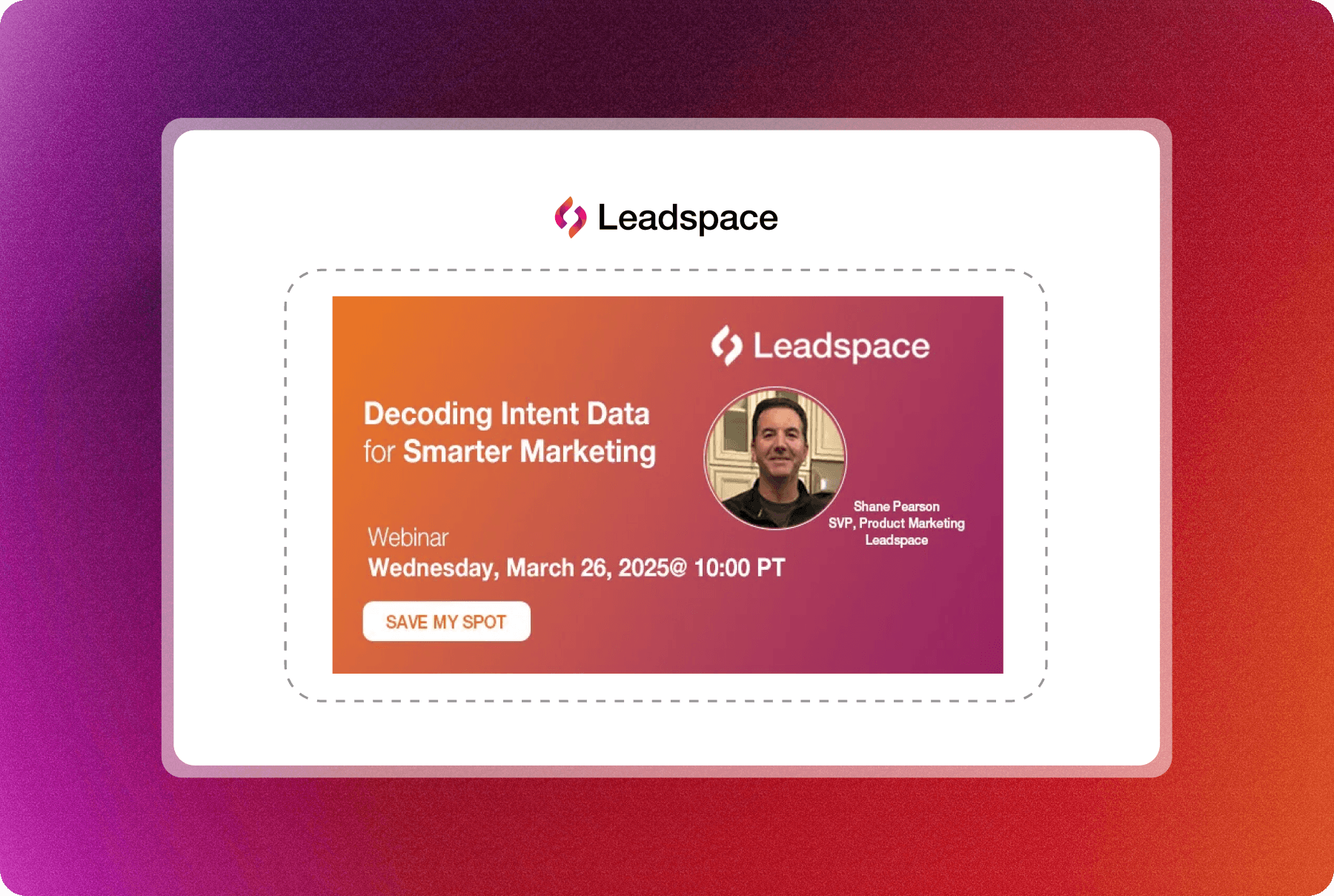
Webinar
Decoding Intent Data for Smarter Marketing
In the complex world of B2B marketing and sales, ensuring that your marketing automation platform (MAP) and customer relationship management (CRM) systems are seamlessly integrated and optimized is crucial for success.


In the complex world of B2B marketing and sales, ensuring that your marketing automation platform (MAP) and customer relationship management (CRM) systems are seamlessly integrated and optimized is crucial for success.
In today’s digital landscape, every interaction leaves a clue about your prospect’s needs and readiness. In just 20 minutes, discover how intent data can improve your marketing approach by turning clues into actionable insights.
Join us as we explore how to see the companies that are searching for your topics and competitors each week with intent data. Figure out who’s in-market and use their locations to identify the specific people to engage with at a target account. Know which product they’re searching to understand the problems they’re looking to solve. See who’s on your website – get an idea of how strongly they’ve considered your solution.
This thought-provoking session will show you how to leverage intent data to not only understand your audience better but also to drive higher conversion rates. Don’t miss your chance to transform digital signals into highly qualified leads.
Latest Articles

Article
Why Waterfall Logic Matters in B2B Data Aggregation
Modern go-to-market teams are swimming in data – firmographics, technographics, intent signals, engagement scores, and countless enrichment sources.
But here’s the truth: more data doesn’t automatically make your business smarter. It often just makes it messier.
When multiple data vendors, enrichment tools, and APIs are all trying to update the same record, the result is chaos – inconsistent fields, conflicting values, duplicates, and manual clean-up that never ends.
That’s where waterfall logic becomes a game-changer.

Article
Why Waterfall Logic Matters in B2B Data Aggregation
Modern go-to-market teams are swimming in data – firmographics, technographics, intent signals, engagement scores, and countless enrichment sources.
But here’s the truth: more data doesn’t automatically make your business smarter. It often just makes it messier.
When multiple data vendors, enrichment tools, and APIs are all trying to update the same record, the result is chaos – inconsistent fields, conflicting values, duplicates, and manual clean-up that never ends.
That’s where waterfall logic becomes a game-changer.

Article
Why Waterfall Logic Matters in B2B Data Aggregation
Modern go-to-market teams are swimming in data – firmographics, technographics, intent signals, engagement scores, and countless enrichment sources.
But here’s the truth: more data doesn’t automatically make your business smarter. It often just makes it messier.
When multiple data vendors, enrichment tools, and APIs are all trying to update the same record, the result is chaos – inconsistent fields, conflicting values, duplicates, and manual clean-up that never ends.
That’s where waterfall logic becomes a game-changer.

Article
10 Ways to Optimize Your GTM Strategy with Dynamic Customer Data
When we outline a comprehensive plan for how to launch a product or expand into a new market, we need market data. To effectively connect with customers, gain a competitive advantage and deliver unique value, we need to understand the people and company profiles that exist in our Total Addressable Market (TAM), and compare how their data relates to our ICP in order to rationalize our predicted success in that market and identify where to start our sales and marketing efforts.
Once we identify the right people and channels to reach them, we rely on their person and company data to create personalized content and campaigns that let them know we’re speaking to them specifically. Unfortunately, people change companies often. They change titles often. And companies go through mergers and acquisitions. Because the data that goes into the profiles across our TAM changes regularly, our traditionally purchased static datasets will inevitably become inaccurate. Spending time, money, and effort personalizing content for someone at their former job or outdated email is a wasted effort and can cost valuable opportunities. Even if you do reach them, referencing an old job title reflects poorly and signals a lack of awareness.
There’s no simple way to know when and which data is outdated, so many data users are forced to update their entire data environment to ensure their teams don’t waste energy on bad information. Unfortunately, manually keeping that data up-to-date across all of your CRM and marketing automation systems is incredibly tedious, cumbersome, expensive and often neglected. GTM leaders need a way to ensure their sales and marketing teams are operating from complete, up-to-date person and company profiles to ensure their GTM efforts are successful. They need dynamic B2B customer data – data that automatically updates across all of their systems.
Using dynamic customer data to improve your go-to-market (GTM) strategy involves leveraging real-time and up-to-date information about your customers to create more effective and targeted marketing and sales efforts. When your customer data is up-to-date, you can confidently utilize that dynamic data to enhance your GTM strategy. Here are 10 ways sales and marketing teams win with dynamic data:

Article
10 Ways to Optimize Your GTM Strategy with Dynamic Customer Data
When we outline a comprehensive plan for how to launch a product or expand into a new market, we need market data. To effectively connect with customers, gain a competitive advantage and deliver unique value, we need to understand the people and company profiles that exist in our Total Addressable Market (TAM), and compare how their data relates to our ICP in order to rationalize our predicted success in that market and identify where to start our sales and marketing efforts.
Once we identify the right people and channels to reach them, we rely on their person and company data to create personalized content and campaigns that let them know we’re speaking to them specifically. Unfortunately, people change companies often. They change titles often. And companies go through mergers and acquisitions. Because the data that goes into the profiles across our TAM changes regularly, our traditionally purchased static datasets will inevitably become inaccurate. Spending time, money, and effort personalizing content for someone at their former job or outdated email is a wasted effort and can cost valuable opportunities. Even if you do reach them, referencing an old job title reflects poorly and signals a lack of awareness.
There’s no simple way to know when and which data is outdated, so many data users are forced to update their entire data environment to ensure their teams don’t waste energy on bad information. Unfortunately, manually keeping that data up-to-date across all of your CRM and marketing automation systems is incredibly tedious, cumbersome, expensive and often neglected. GTM leaders need a way to ensure their sales and marketing teams are operating from complete, up-to-date person and company profiles to ensure their GTM efforts are successful. They need dynamic B2B customer data – data that automatically updates across all of their systems.
Using dynamic customer data to improve your go-to-market (GTM) strategy involves leveraging real-time and up-to-date information about your customers to create more effective and targeted marketing and sales efforts. When your customer data is up-to-date, you can confidently utilize that dynamic data to enhance your GTM strategy. Here are 10 ways sales and marketing teams win with dynamic data:

Article
10 Ways to Optimize Your GTM Strategy with Dynamic Customer Data
When we outline a comprehensive plan for how to launch a product or expand into a new market, we need market data. To effectively connect with customers, gain a competitive advantage and deliver unique value, we need to understand the people and company profiles that exist in our Total Addressable Market (TAM), and compare how their data relates to our ICP in order to rationalize our predicted success in that market and identify where to start our sales and marketing efforts.
Once we identify the right people and channels to reach them, we rely on their person and company data to create personalized content and campaigns that let them know we’re speaking to them specifically. Unfortunately, people change companies often. They change titles often. And companies go through mergers and acquisitions. Because the data that goes into the profiles across our TAM changes regularly, our traditionally purchased static datasets will inevitably become inaccurate. Spending time, money, and effort personalizing content for someone at their former job or outdated email is a wasted effort and can cost valuable opportunities. Even if you do reach them, referencing an old job title reflects poorly and signals a lack of awareness.
There’s no simple way to know when and which data is outdated, so many data users are forced to update their entire data environment to ensure their teams don’t waste energy on bad information. Unfortunately, manually keeping that data up-to-date across all of your CRM and marketing automation systems is incredibly tedious, cumbersome, expensive and often neglected. GTM leaders need a way to ensure their sales and marketing teams are operating from complete, up-to-date person and company profiles to ensure their GTM efforts are successful. They need dynamic B2B customer data – data that automatically updates across all of their systems.
Using dynamic customer data to improve your go-to-market (GTM) strategy involves leveraging real-time and up-to-date information about your customers to create more effective and targeted marketing and sales efforts. When your customer data is up-to-date, you can confidently utilize that dynamic data to enhance your GTM strategy. Here are 10 ways sales and marketing teams win with dynamic data:

Article
Mastering B2B Buying Groups with Hierarchies & Persona Scores
As most B2B sales and marketers know, the vast majority of our contacts at any target account don’t have the power to buy our products. Figuring out the handful of people who do have that power is critical to ensuring that your highly-personalized content and precision outreach actually leads to revenue.
A buying group, typically, is a composition of various business leaders and stakeholders who play different roles in the decision-making process at a company. Identifying buying groups in B2B sales and marketing is crucial for targeting the right individuals within an organization who influence the purchasing decision.
Identifying buying groups in B2B sales and marketing generally requires a combination of data analysis, outreach, and ongoing engagement with multiple stakeholders within an organization.
By understanding the roles and influence of each member in the buying group, you can tailor your sales and marketing efforts to address their specific needs and ultimately drive more effective and efficient sales processes.

Article
Mastering B2B Buying Groups with Hierarchies & Persona Scores
As most B2B sales and marketers know, the vast majority of our contacts at any target account don’t have the power to buy our products. Figuring out the handful of people who do have that power is critical to ensuring that your highly-personalized content and precision outreach actually leads to revenue.
A buying group, typically, is a composition of various business leaders and stakeholders who play different roles in the decision-making process at a company. Identifying buying groups in B2B sales and marketing is crucial for targeting the right individuals within an organization who influence the purchasing decision.
Identifying buying groups in B2B sales and marketing generally requires a combination of data analysis, outreach, and ongoing engagement with multiple stakeholders within an organization.
By understanding the roles and influence of each member in the buying group, you can tailor your sales and marketing efforts to address their specific needs and ultimately drive more effective and efficient sales processes.

Article
Mastering B2B Buying Groups with Hierarchies & Persona Scores
As most B2B sales and marketers know, the vast majority of our contacts at any target account don’t have the power to buy our products. Figuring out the handful of people who do have that power is critical to ensuring that your highly-personalized content and precision outreach actually leads to revenue.
A buying group, typically, is a composition of various business leaders and stakeholders who play different roles in the decision-making process at a company. Identifying buying groups in B2B sales and marketing is crucial for targeting the right individuals within an organization who influence the purchasing decision.
Identifying buying groups in B2B sales and marketing generally requires a combination of data analysis, outreach, and ongoing engagement with multiple stakeholders within an organization.
By understanding the roles and influence of each member in the buying group, you can tailor your sales and marketing efforts to address their specific needs and ultimately drive more effective and efficient sales processes.