Resources Hub

Article
Why Data Governance Is Now a Revenue Function
For a long time, data governance lived in the background of the business.
It sat inside IT. Sometimes legal. Occasionally security... It was something you needed for compliance audits, privacy policies, and system hygiene, but it rarely gets associated with pipeline creation or revenue performance. If anything, governance was seen as something that slowed go-to-market teams down. It was an approval layer or process hurdle that prevented a campaign from launching this week.
But that mental model was built for a very different GTM environment than the one enterprise revenue teams are operating in right now.
Product sheet
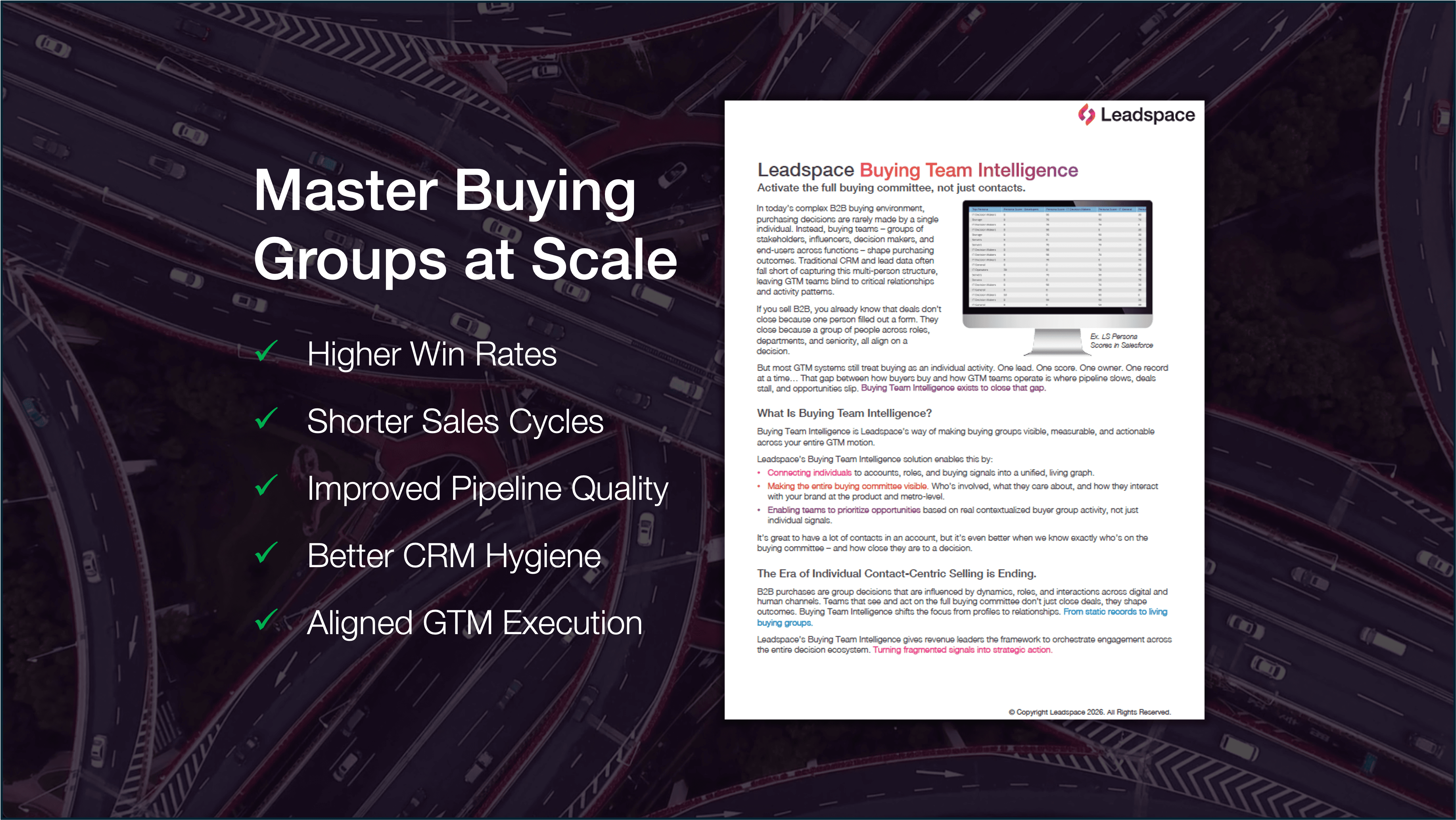
Leadspace Buying Team Intelligence
B2B deals don’t close because one contact engages, they close when an entire buying committee aligns. Yet most GTM systems still operate at the individual record level, leaving revenue teams blind to the relationships, roles, and signals that actually drive decisions.
Leadspace’s Buying Team Intelligence makes buying groups visible, measurable, and actionable by connecting people to roles, accounts, hierarchies, and real-time buying signals in a unified, living data graph.
The result: sales, marketing, and RevOps teams can identify who truly influences and approves decisions, prioritize accounts showing coordinated buying activity, and orchestrate multithreaded engagement based on how buyers actually buy rather than on how CRM records are structured.
Product sheet
Leadspace Buying Team Intelligence
B2B deals don’t close because one contact engages, they close when an entire buying committee aligns. Yet most GTM systems still operate at the individual record level, leaving revenue teams blind to the relationships, roles, and signals that actually drive decisions.
Leadspace’s Buying Team Intelligence makes buying groups visible, measurable, and actionable by connecting people to roles, accounts, hierarchies, and real-time buying signals in a unified, living data graph.
The result: sales, marketing, and RevOps teams can identify who truly influences and approves decisions, prioritize accounts showing coordinated buying activity, and orchestrate multithreaded engagement based on how buyers actually buy rather than on how CRM records are structured.
Product sheet
Leadspace Buying Team Intelligence
B2B deals don’t close because one contact engages, they close when an entire buying committee aligns. Yet most GTM systems still operate at the individual record level, leaving revenue teams blind to the relationships, roles, and signals that actually drive decisions.
Leadspace’s Buying Team Intelligence makes buying groups visible, measurable, and actionable by connecting people to roles, accounts, hierarchies, and real-time buying signals in a unified, living data graph.
The result: sales, marketing, and RevOps teams can identify who truly influences and approves decisions, prioritize accounts showing coordinated buying activity, and orchestrate multithreaded engagement based on how buyers actually buy rather than on how CRM records are structured.
Product sheet
Leadspace Buying Team Intelligence
B2B deals don’t close because one contact engages, they close when an entire buying committee aligns. Yet most GTM systems still operate at the individual record level, leaving revenue teams blind to the relationships, roles, and signals that actually drive decisions.
Leadspace’s Buying Team Intelligence makes buying groups visible, measurable, and actionable by connecting people to roles, accounts, hierarchies, and real-time buying signals in a unified, living data graph.
The result: sales, marketing, and RevOps teams can identify who truly influences and approves decisions, prioritize accounts showing coordinated buying activity, and orchestrate multithreaded engagement based on how buyers actually buy rather than on how CRM records are structured.

Article
Why Waterfall Logic Matters in B2B Data Aggregation
Modern go-to-market teams are swimming in data – firmographics, technographics, intent signals, engagement scores, and countless enrichment sources.
But here’s the truth: more data doesn’t automatically make your business smarter. It often just makes it messier.
When multiple data vendors, enrichment tools, and APIs are all trying to update the same record, the result is chaos – inconsistent fields, conflicting values, duplicates, and manual clean-up that never ends.
That’s where waterfall logic becomes a game-changer.
Article
Why Waterfall Logic Matters in B2B Data Aggregation
Modern go-to-market teams are swimming in data – firmographics, technographics, intent signals, engagement scores, and countless enrichment sources.
But here’s the truth: more data doesn’t automatically make your business smarter. It often just makes it messier.
When multiple data vendors, enrichment tools, and APIs are all trying to update the same record, the result is chaos – inconsistent fields, conflicting values, duplicates, and manual clean-up that never ends.
That’s where waterfall logic becomes a game-changer.
Article
Why Waterfall Logic Matters in B2B Data Aggregation
Modern go-to-market teams are swimming in data – firmographics, technographics, intent signals, engagement scores, and countless enrichment sources.
But here’s the truth: more data doesn’t automatically make your business smarter. It often just makes it messier.
When multiple data vendors, enrichment tools, and APIs are all trying to update the same record, the result is chaos – inconsistent fields, conflicting values, duplicates, and manual clean-up that never ends.
That’s where waterfall logic becomes a game-changer.
Article
Why Waterfall Logic Matters in B2B Data Aggregation
Modern go-to-market teams are swimming in data – firmographics, technographics, intent signals, engagement scores, and countless enrichment sources.
But here’s the truth: more data doesn’t automatically make your business smarter. It often just makes it messier.
When multiple data vendors, enrichment tools, and APIs are all trying to update the same record, the result is chaos – inconsistent fields, conflicting values, duplicates, and manual clean-up that never ends.
That’s where waterfall logic becomes a game-changer.

Article
Why Keeping B2B Profiles Up-to-Date Boosts Sales & Marketing Success
Keeping B2B buyer profiles up-to-date is essential for maintaining effective sales and marketing strategies. Unfortunately, keeping profiles up-to-date is tedious and often neglected. Failing to update our customer or buyer profiles does your sales and marketing teams a tremendous disservice. Your teams could spend thousands of dollars and weeks of focus trying to get in touch with a great lead from last year, completely unaware that the person changed jobs three months ago – all because their profile within your CRM and marketing automation systems wasn’t up-to-date. People change jobs and companies go throughM&A all the time – and your sales and marketing teams need to stay informed. That’s just one of the many ways your teams will lose with outdated buyer profiles. Having accurate, up-to-date data seems like a no-brainer, right? Let’s consider why many sales and marketing teams don’t always have the data they need.
It takes a lot of buying signals to build the buyer profiles that our sales and marketing teams need to win business. Firmographics, demographics, technographics, intent, 1st-party data, predictive and engagement. Generally speaking, we can’t get all of those signals from one place. Instead, we’re forced to buy numerous sets of static data from several vendors, then blend it all together. Buying multiple sets of data from multiple sources is inherently expensive, and manually combining that data with our first-party data is time-consuming, cumbersome and error-prone. We might jump through those hurdles at first, but the problem arises when we need to update it.
A static data set is just a snapshot in time, and there’s no way to tell when data has changed to the point where you need a new snapshot. This means that in order to ensure our buyer profiles are up-to-date, we need to regularly buy all of our data over and over again, continuously blending it all together with the old data. That’s going to be very expensive, and it’s going to require a lot of time and effort dedicated to data unification. In many cases, by the time you’ve enriched your new data with the old data, that new data has already become old data. Naturally, many companies will decide that their slightly old data is good enough because they can’t justify the cost of constant data purchases or the time spent unifying it.
Not updating your buyer profiles is a huge mistake in a world of data-driven decision making, where all of the decisions you make depend on having accurate, complete and up-to-date data. Even the best predictive AI models will point you in the wrong direction if the data being analyzed isn’t correct. Simply put, if you want your sales and marketing teams to have the tools they need to reach out and close business, you need to give them buyer profiles that are dynamically updated.
Let’s look at 10 common strategies for ensuring that your buyer profiles are current and accurate, then consider a more realistic solution for automating the entire process.
Article
Why Keeping B2B Profiles Up-to-Date Boosts Sales & Marketing Success
Keeping B2B buyer profiles up-to-date is essential for maintaining effective sales and marketing strategies. Unfortunately, keeping profiles up-to-date is tedious and often neglected. Failing to update our customer or buyer profiles does your sales and marketing teams a tremendous disservice. Your teams could spend thousands of dollars and weeks of focus trying to get in touch with a great lead from last year, completely unaware that the person changed jobs three months ago – all because their profile within your CRM and marketing automation systems wasn’t up-to-date. People change jobs and companies go throughM&A all the time – and your sales and marketing teams need to stay informed. That’s just one of the many ways your teams will lose with outdated buyer profiles. Having accurate, up-to-date data seems like a no-brainer, right? Let’s consider why many sales and marketing teams don’t always have the data they need.
It takes a lot of buying signals to build the buyer profiles that our sales and marketing teams need to win business. Firmographics, demographics, technographics, intent, 1st-party data, predictive and engagement. Generally speaking, we can’t get all of those signals from one place. Instead, we’re forced to buy numerous sets of static data from several vendors, then blend it all together. Buying multiple sets of data from multiple sources is inherently expensive, and manually combining that data with our first-party data is time-consuming, cumbersome and error-prone. We might jump through those hurdles at first, but the problem arises when we need to update it.
A static data set is just a snapshot in time, and there’s no way to tell when data has changed to the point where you need a new snapshot. This means that in order to ensure our buyer profiles are up-to-date, we need to regularly buy all of our data over and over again, continuously blending it all together with the old data. That’s going to be very expensive, and it’s going to require a lot of time and effort dedicated to data unification. In many cases, by the time you’ve enriched your new data with the old data, that new data has already become old data. Naturally, many companies will decide that their slightly old data is good enough because they can’t justify the cost of constant data purchases or the time spent unifying it.
Not updating your buyer profiles is a huge mistake in a world of data-driven decision making, where all of the decisions you make depend on having accurate, complete and up-to-date data. Even the best predictive AI models will point you in the wrong direction if the data being analyzed isn’t correct. Simply put, if you want your sales and marketing teams to have the tools they need to reach out and close business, you need to give them buyer profiles that are dynamically updated.
Let’s look at 10 common strategies for ensuring that your buyer profiles are current and accurate, then consider a more realistic solution for automating the entire process.
Article
Why Keeping B2B Profiles Up-to-Date Boosts Sales & Marketing Success
Keeping B2B buyer profiles up-to-date is essential for maintaining effective sales and marketing strategies. Unfortunately, keeping profiles up-to-date is tedious and often neglected. Failing to update our customer or buyer profiles does your sales and marketing teams a tremendous disservice. Your teams could spend thousands of dollars and weeks of focus trying to get in touch with a great lead from last year, completely unaware that the person changed jobs three months ago – all because their profile within your CRM and marketing automation systems wasn’t up-to-date. People change jobs and companies go throughM&A all the time – and your sales and marketing teams need to stay informed. That’s just one of the many ways your teams will lose with outdated buyer profiles. Having accurate, up-to-date data seems like a no-brainer, right? Let’s consider why many sales and marketing teams don’t always have the data they need.
It takes a lot of buying signals to build the buyer profiles that our sales and marketing teams need to win business. Firmographics, demographics, technographics, intent, 1st-party data, predictive and engagement. Generally speaking, we can’t get all of those signals from one place. Instead, we’re forced to buy numerous sets of static data from several vendors, then blend it all together. Buying multiple sets of data from multiple sources is inherently expensive, and manually combining that data with our first-party data is time-consuming, cumbersome and error-prone. We might jump through those hurdles at first, but the problem arises when we need to update it.
A static data set is just a snapshot in time, and there’s no way to tell when data has changed to the point where you need a new snapshot. This means that in order to ensure our buyer profiles are up-to-date, we need to regularly buy all of our data over and over again, continuously blending it all together with the old data. That’s going to be very expensive, and it’s going to require a lot of time and effort dedicated to data unification. In many cases, by the time you’ve enriched your new data with the old data, that new data has already become old data. Naturally, many companies will decide that their slightly old data is good enough because they can’t justify the cost of constant data purchases or the time spent unifying it.
Not updating your buyer profiles is a huge mistake in a world of data-driven decision making, where all of the decisions you make depend on having accurate, complete and up-to-date data. Even the best predictive AI models will point you in the wrong direction if the data being analyzed isn’t correct. Simply put, if you want your sales and marketing teams to have the tools they need to reach out and close business, you need to give them buyer profiles that are dynamically updated.
Let’s look at 10 common strategies for ensuring that your buyer profiles are current and accurate, then consider a more realistic solution for automating the entire process.
Article
Why Keeping B2B Profiles Up-to-Date Boosts Sales & Marketing Success
Keeping B2B buyer profiles up-to-date is essential for maintaining effective sales and marketing strategies. Unfortunately, keeping profiles up-to-date is tedious and often neglected. Failing to update our customer or buyer profiles does your sales and marketing teams a tremendous disservice. Your teams could spend thousands of dollars and weeks of focus trying to get in touch with a great lead from last year, completely unaware that the person changed jobs three months ago – all because their profile within your CRM and marketing automation systems wasn’t up-to-date. People change jobs and companies go throughM&A all the time – and your sales and marketing teams need to stay informed. That’s just one of the many ways your teams will lose with outdated buyer profiles. Having accurate, up-to-date data seems like a no-brainer, right? Let’s consider why many sales and marketing teams don’t always have the data they need.
It takes a lot of buying signals to build the buyer profiles that our sales and marketing teams need to win business. Firmographics, demographics, technographics, intent, 1st-party data, predictive and engagement. Generally speaking, we can’t get all of those signals from one place. Instead, we’re forced to buy numerous sets of static data from several vendors, then blend it all together. Buying multiple sets of data from multiple sources is inherently expensive, and manually combining that data with our first-party data is time-consuming, cumbersome and error-prone. We might jump through those hurdles at first, but the problem arises when we need to update it.
A static data set is just a snapshot in time, and there’s no way to tell when data has changed to the point where you need a new snapshot. This means that in order to ensure our buyer profiles are up-to-date, we need to regularly buy all of our data over and over again, continuously blending it all together with the old data. That’s going to be very expensive, and it’s going to require a lot of time and effort dedicated to data unification. In many cases, by the time you’ve enriched your new data with the old data, that new data has already become old data. Naturally, many companies will decide that their slightly old data is good enough because they can’t justify the cost of constant data purchases or the time spent unifying it.
Not updating your buyer profiles is a huge mistake in a world of data-driven decision making, where all of the decisions you make depend on having accurate, complete and up-to-date data. Even the best predictive AI models will point you in the wrong direction if the data being analyzed isn’t correct. Simply put, if you want your sales and marketing teams to have the tools they need to reach out and close business, you need to give them buyer profiles that are dynamically updated.
Let’s look at 10 common strategies for ensuring that your buyer profiles are current and accurate, then consider a more realistic solution for automating the entire process.